A foldable wireless charger is worth buying when four things are right: the hinge holds the phone without sagging, the magnets align the charging coil, the USB-C input can supply the needed power, and the folded kit travels safely. For brand owners, importers, distributors and promotional-gift buyers, the safest choice is not the thinnest model on a listing page, but the one with clear standard claims, a complete adapter-and-cable plan, and packaging that protects the product in real travel use.
A fast choice map
Start with the user situation, not the product photo. A charger that looks elegant on a desk may be awkward in a suitcase, while a compact travel pad may not stand the phone at a useful viewing angle.
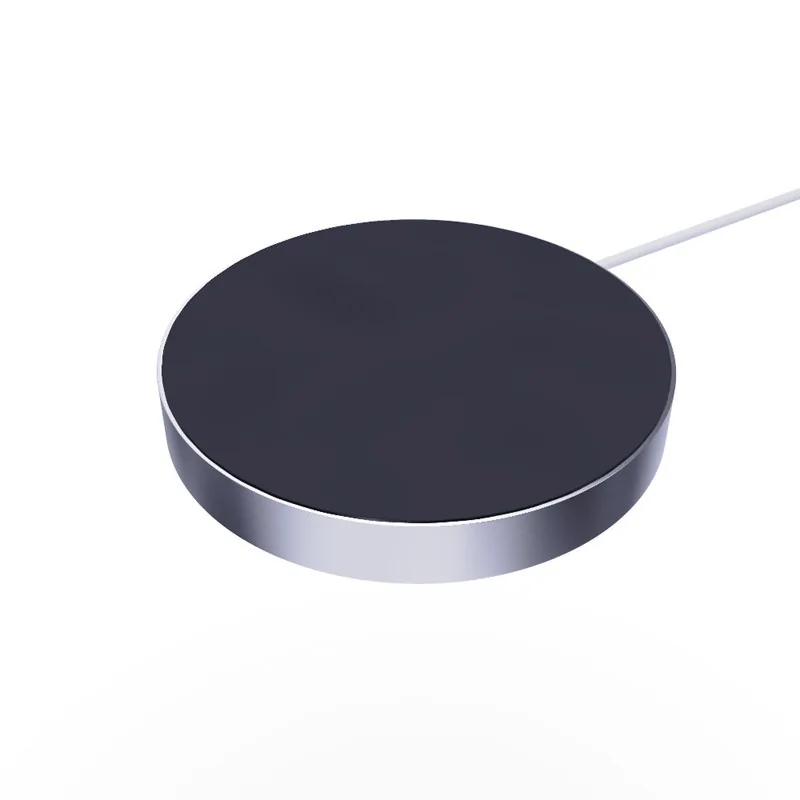
- Phone only: choose a magnetic pad or a small folding stand if the buyer wants the lowest packing volume.
- Phone plus earbuds: choose a two-zone layout with enough space so the earbud case does not block the phone coil.
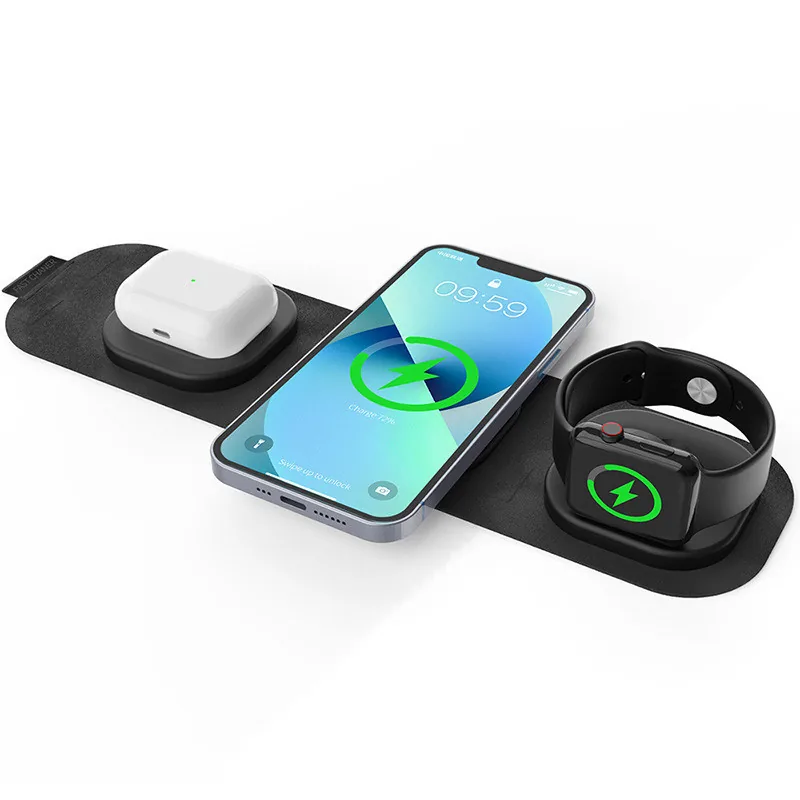
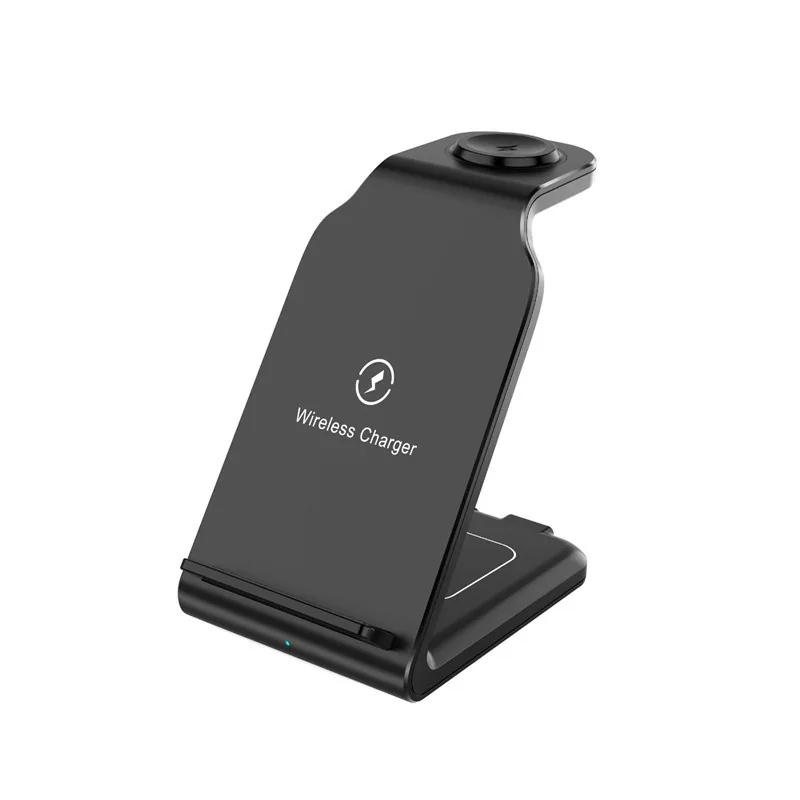
- Full Apple travel kit: choose a three-zone layout for phone, earbuds and watch, and confirm whether the watch module is built into the product or supplied as a separate insert.
- Android and Qi2 users: check the Wireless Power Consortium certification claim, because Qi2 uses magnetic attachment for alignment and supports 15 W charging for certified mobile devices.
- Travel charger: check folded size, cable storage and whether a wall adapter or plug adapters are included.
- Desk stand: check viewing angle, base stability and whether the hinge stays firm when the phone is tapped.
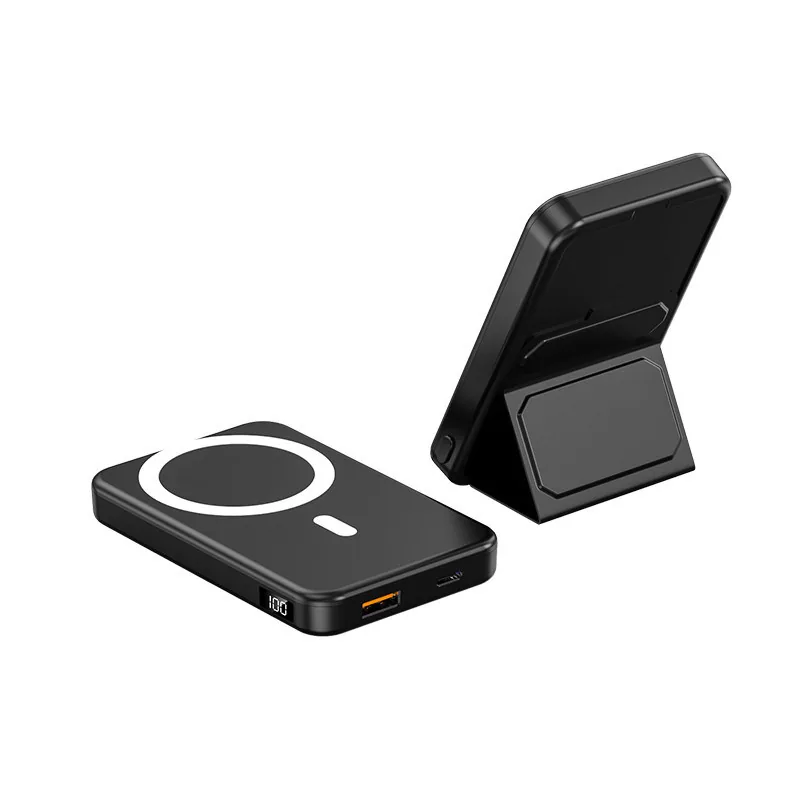
- Foldable wireless power bank: treat battery safety, airline rules and heat as a separate buying topic; magnetic power banks are not the same product class as a passive travel charging station.
If you are comparing custom-branded options, start with a layout category such as portable wireless chargers, then narrow the choice by charging standard, hinge structure, kit contents and packaging.
Charging standard and power input set real speed
Qi is the Wireless Power Consortium wireless charging standard. WPC says only Qi Certified products may display the Qi or Qi2 logo after independent lab testing for safety and interoperability. That matters in procurement because a magnetic ring and a Qi2 logo are not the same thing.
Qi2 added magnetic attachment so the device and charger align more reliably. WPC lists Qi v2.0, released in April 2023, as introducing the Magnetic Power Profile, magnetic attachment and alignment between transmitter and receiver, and detailed magnetic power-loss accounting. WPC also says Qi2 brings 15 W charging to certified mobile devices, while Qi2 25W and Qi v2.2 increase power up to 25 W.
USB-C input is the next limit. USB Power Delivery, often shortened to USB PD, is a system that lets devices take only the power they require and obtain more power when needed. USB-IF says USB PD Revision 3.1 supports up to 240 W over a full-featured USB Type-C cable and connector, but that does not mean every folding charger, cable or wall plug can use that power. The charger must request the correct profile, the adapter must provide it, and the cable must be suitable.
Apple gives a useful example for its MagSafe Charger safety document. It recommends USB-C power adapters with 100–240 VAC input, 15 VDC/2.33 A output and at least 35 W, and it lists system input options of 15 V/3 A, 9 V/3 A or 5 V/3 A. That is not a universal specification for every travel charger, but it shows why a random low-power USB-C plug can reduce performance or cause unstable behaviour.
Ask the supplier to state:
- The wireless standard claim for each charging zone.
- The phone charging output under each supported standard.
- The USB-C input profiles required by the charger.
- Whether the adapter is included or optional.
- Whether the cable is USB-C to USB-C and suitable for the required power.
- What happens when all charging zones are used at the same time.
USB-IF also says not all USB cables have the same capabilities, and that USB-C to USB-C cable categories in its compliance program must be labelled with 60 W or 240 W power capability logos. For a retail kit, the cable is part of the product experience; for a promotional-gift kit, it is also part of the risk.
Hinge, magnets and device fit are the hard parts
The hinge is not just a convenience feature. It controls the phone angle, keeps the coil position stable, and decides whether the charger still feels premium after repeated folding.
A good sample review should include:
- Open the charger and place the heaviest target phone on the phone pad.
- Tap the screen near the top edge and watch for bounce or slow collapse.
- Test portrait and landscape positions if the pad is meant to support both.
- Check whether the hinge holds at the advertised viewing angle.
- Fold and unfold the sample repeatedly during inspection and listen for clicking, grinding or looseness.
- Check whether the charging cable pulls the stand backwards when connected.
Magnets need the same discipline. Qi2 uses magnetic attachment for alignment, but a product can have magnets without being Qi2 Certified. If the listing says magnetic alignment, ask whether it is Qi2 Certified, Qi Certified with magnets, or simply a non-certified magnetic ring. If the Qi or Qi2 logo appears on packaging or a product page, ask for proof that the specific model may display it.
Device fit is where many attractive designs become frustrating. WPC says Qi v2.1 added a test for mechanical obstructions such as protruding camera areas near a phone charging zone. That is directly relevant to folding stands, because a raised phone pad, camera bump, thick case, watch band or earbud case can stop the device from sitting flat on the coil.
Do not accept a broad compatibility sentence on its own. Ask for sample testing with the target phones and cases, and make sure the supplier tests the watch band positions and earbud case orientation that your customers will actually use.
Packing the travel kit
A travel charger is a small system: charging pad, cable, adapter, plug options, pouch or case, and instruction sheet. If one part is missing, the customer may blame the charger rather than the missing accessory.
Belkin identifies its BoostCharge Pro WIZ024 as a three-in-one foldable travel charger for iPhone, AirPods and Apple Watch. Its listed box contents include the charger, a 1.5 m USB-C to USB-C cable, a 36 W USB-C power supply and a travel case. Belkin lists folded dimensions of 82 x 82 x 28 mm, flat dimensions of 168 x 82 x 11.5 mm and weight of 0.34 kg.
Mophie lists a 3-in-1 Portable Travel Charger with MagSafe Global Edition as Qi2-certified and MagSafe compatible, with designated charging spots for Apple devices. It says the iPhone charging surface lifts for StandBy mode in landscape orientation, the Qi2 magnetic output is 15 W, and the kit includes a 40 W international wall adapter, USB-C cable and travel pouch. It lists dimensions of 2.8 x 5.8 x 0.6 inches and weight of 0.375 lb.
Those examples are useful because they show what buyers should compare: folded volume, open footprint, adapter wattage, cable, pouch and the way the phone pad stands up.
| Use case | Include | Check |
|---|---|---|
| Hotel travel | Adapter, pouch | Folded size |
| Retail kit | Cable, manual | Box clarity |
| Gift program | Logo, insert | Pack protection |
Keep metallic objects away from magnetic wireless chargers. Apple warns that metallic cases and objects such as keys, coins, batteries, jewellery, RFID cards, passports and access cards can interfere with charging, heat up or be damaged, and that magnets and radios may interfere with medical devices.
The pouch or case should stop the charger from rubbing against the adapter prongs and cable ends. It should also make it easy for the user to pack cards, passports, keys and coins away from the charging surface.
Bulk sourcing checklist and RFQ wording
For a brand, importer, distributor or promotional-gift buyer, the purchase decision should be written down before samples are ordered. Shenzhen Sunning Tension Industrial Co., Ltd. in Bao'an, Shenzhen makes wireless chargers, USB cables and wireless charging power banks to order for brands, importers, distributors and promotional-gift buyers, with custom logos and packaging; it does not sell its own consumer brand. For project planning, use an OEM and ODM brief rather than relying on a listing title.
Your sourcing checklist should cover:
- Product layout: phone-only, two-in-one, three-in-one, desk stand, travel pad or wireless charging power bank.
- Standard claim: Qi, Qi2, Qi2 25W or another clearly named standard claim.
- Certification evidence: whether the exact model may display the Qi or Qi2 logo.
- Input: USB-C profiles, adapter requirement and whether the adapter is included.
- Cable: length, connector type and power capability.
- Hinge: target angle, locking feel and sample acceptance test.
- Magnets: alignment performance with the target phones and cases.
- Device fit: camera bump clearance, case limitations, watch band clearance and earbud case placement.
- Heat and safety: abnormal heat, odour, deformation, abrasion, cuts or abnormal behaviour should stop the test immediately, matching the warning language in the mophie manual.
- Packaging: retail box, travel pouch, cable storage, instruction sheet and barcode or importer information as required for your market.
- Branding: logo position, print method, colour, gift-box artwork and approval sample.
- Inspection: visual checks, charging checks, hinge checks, accessory checks and packaging checks.
A practical RFQ can be short, but it must be specific:
- Product type: foldable magnetic travel charger for phone, earbuds and watch.
- Wireless standard: state required Qi or Qi2 claim and logo use requirements.
- Phone output: state the required output under the chosen standard.
- Input: state USB-C profiles and adapter requirement.
- Cable: state connector type and length.
- Adapter: included, optional or excluded.
- Packing: travel pouch, retail box and user manual.
- Finish: material, colour and logo position.
- Compatibility sample list: phones, cases, watch bands and earbud cases to test.
- Approval: sample must pass charging, hinge, magnet, fit and packing checks before bulk order approval.
A buyer can ask for a quotation or a sample through the contact page when the specification is ready.
Risk points in low-cost travel chargers
A low purchase price can hide missing information. The first warning sign is unclear certification language. If a product says Qi2 style, magnetic compatible or fast magnetic without naming the certification status, ask what can legally appear on the product and packaging.
The second warning sign is an under-specified adapter. A charger may be marketed with a high phone output, but the included adapter or the customer’s own plug may not support the input profile the charger needs. USB PD helps devices negotiate power, but it cannot create power that the adapter and cable do not provide.
The third warning sign is a weak hinge. Thin travel products are attractive, but the phone pad must not fold flat under the phone’s weight or wobble when touched. This is especially important when the charger is sold as suitable for bedside use, video calls or landscape viewing.
The fourth warning sign is heat. The mophie and ZAGG manual warns that improper use may cause product damage, excess heat, toxic fumes, fire or explosion. It also says not to expose the charger to rain or snow, not to exceed its output rating, not to use a power supply or charger not recommended by mophie, and to stop using the product immediately if there is abnormal heat, odour, deformation, abrasion, cuts or abnormal behaviour.
The fifth warning sign is packaging that is not retail-ready. A travel charger with no pouch, loose cable and unclear adapter requirement may pass a sample photo review but disappoint the end user.
Questions and answers
Will a foldable wireless charger still charge fast if I use my own USB-C plug?
It depends on the plug, cable and charger input profile. USB Power Delivery lets devices request the power they need, but the adapter and cable must support that request. Ask the supplier for the required USB-C input profiles and test the sample with the exact adapter plan you will sell or recommend.
How do I know if the magnets are real Qi2 alignment or just a ring?
Ask whether the exact model is Qi2 Certified and whether it may display the Qi2 logo. WPC says only Qi Certified products may display the Qi or Qi2 logo after independent lab testing. A magnetic feel alone does not prove Qi2 certification.
What hinge design should I look for?
Look for a hinge that holds the phone angle under normal screen taps, does not drift backward, and does not loosen during repeated folding. During sample approval, test the heaviest target phone, portrait and landscape positions, the connected cable, and the fully folded packing position.
Can my case, camera bump or watch band stop charging?
Yes, physical obstruction can affect alignment. WPC notes that Qi v2.1 added a test for mechanical obstructions such as protruding camera areas near a phone charging zone. Test with the real cases, camera bumps, watch bands and earbud cases used by your target customers.
What should be included in a good travel kit?
At minimum, define the charger, USB-C cable, adapter decision, pouch or case, and manual. Some travel products include a wall adapter and travel case; others leave the adapter to the user. For bulk buying, the important point is that the kit contents match the power requirement and the packaging promise.
What standards should an importer ask about?
Ask about Qi or Qi2 certification status, USB-C input profiles, USB cable capability, adapter safety standard claims and market compliance documents. IEC 62368-1:2023 is a product-safety standard for audio/video, information and communication technology equipment, and it describes safeguards intended to reduce the likelihood of pain, injury, fire and property damage.
Sources
- Wireless Power Consortium: Qi Wireless charging
- Wireless Power Consortium: History of the Qi Specifications
- Apple: Safety and Handling
- USB Implementers Forum: USB Charger (USB Power Delivery)
- USB Implementers Forum: Cables and Connectors
- International Electrotechnical Commission: IEC 62368-1:2023
- Belkin: Belkin BoostCharge Pro 3-in-1 Magnetic Wireless Charging Travel Pad with Qi2 15W (WIZ024) FAQs
- mophie: 3-in-1 Portable Travel Charger with MagSafe Global Edition
- mophie: 3-in-1 Travel Charger with MagSafe - Fabric Pouch
- mophie / ZAGG: 3-in-1 Travel Charger – Global Edition User Manual
Written by the engineering team at Shenzhen Sunning Tension Industrial Co., Ltd., an OEM and ODM factory in Bao’an, Shenzhen making consumer electronics and supplying custom-branded gifts. Ask a question about your own specification →